The Science of Ground Feel: How Thin-Sole Engineering Redefines the Barefoot Experience
“Ground feel” is the soul of the barefoot shoe category. It’s the reason buyers switch from traditional footwear, the promise on every minimalist brand’s homepage, and—too often—the vague marketing phrase that hides a real engineering problem. Because here’s the truth: a thin sole is not the same thing as a well-engineered thin sole. Ground feel is not about how little shoe you can get away with. It’s about how precisely you can transmit information from the ground to the nervous system while still protecting the foot. That is an engineering problem, and it deserves engineering answers.
What Is Ground Feel, Really? Proprioception You Can Feel
Ground feel is proprioception: your body’s ability to sense position, pressure, and texture through the mechanoreceptors in your feet. Every millimeter of sole material between your foot and the ground filters that signal. A well-designed thin sole doesn’t just remove material—it curates what passes through it. Pressure gradients, surface texture, even subtle changes in terrain: these are the data your customer’s nervous system is hungry for, and the sole is the filter.
The 4/6/8mm Decision: Thickness Is a Spectrum, Not a Religion
There is no single “correct” stack height. The right thickness depends on the use case, and the best brands offer a spectrum:
- 4mm — Maximum Sensory: For training, balance work, and experienced barefooters who want pure ground contact.
- 6mm — The Daily Sweet Spot: Enough protection for urban surfaces and long walks, without losing meaningful ground feel.
- 8mm — Transition & Trail: Entry-level protection for customers new to minimalist shoes, or for rugged terrain.
The engineering skill is not in picking one number. It’s in making every number feel better than it should—which is where multi-density construction enters.
Multi-Density Outsoles: Protection Where It Matters, Sensation Where It Counts
A single slab of foam is a compromise. Dense enough to protect, it deadens sensation. Soft enough to transmit, it wears out fast and offers no puncture resistance. The professional answer is a multi-density outsole—a single piece of rubber engineered with different durometers in different zones:
- Firm, protective zones under the heel and forefoot impact points.
- A supple, highly flexible flex-zone at the metatarsal head for natural toe-off.
- A thin, responsive center that transmits texture and pressure gradients.
This is the difference between a shoe that merely has a thin sole and one that delivers genuine ground feel without compromising durability.
Zero Drop and the Alignment Story
Zero drop—an equal heel-to-toe stack height—is non-negotiable in the category, but it’s not the whole story. The real win is a sole that keeps the foot in its natural alignment across the entire gait cycle. That requires the outsole to flex in the same places the foot flexes, and to stay stable where the foot needs support. Anatomy-driven flex grooves, not decorative tread lines, make the difference.
Tread Without Sacrifice: Traction That Doesn’t Mute the Signal
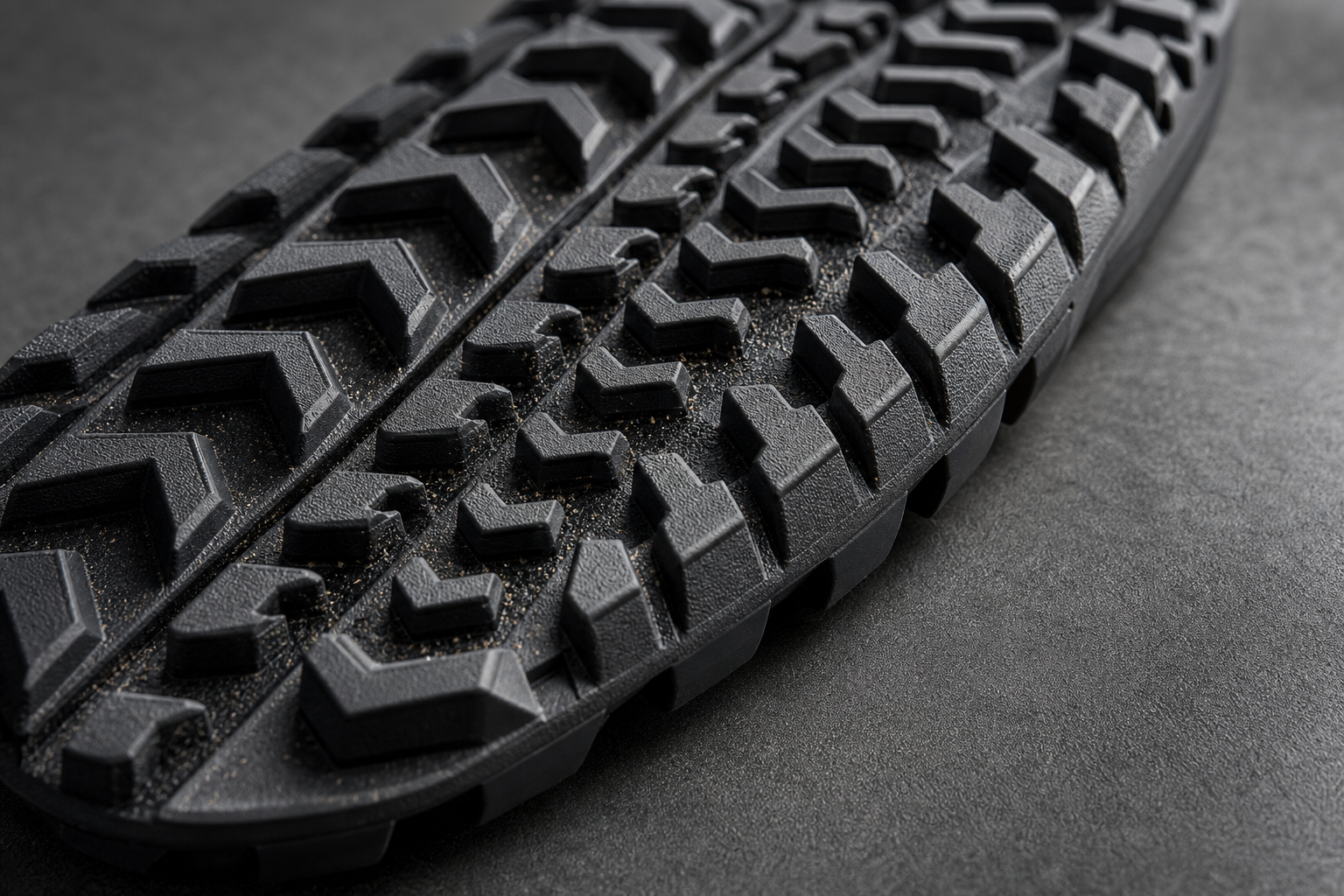
The perennial objection to thin soles is wet-weather traction. The answer is not a thicker sole—it’s smarter tread engineering. A directional multi-directional lug pattern, shallow enough to preserve surface feedback but shaped to channel water and bite into slick surfaces, solves the traction problem without adding a millimeter of dead foam.
Materials That Transmit: The Rubber Formula Matters
Not all rubber transmits equally. High-traction natural rubber compounds with silica reinforcement offer both grip and signal fidelity, while remaining abrasion-resistant for street durability. The compound is where “thin but tough” becomes a verifiable spec, not a slogan.
Why This Matters for Your Brand
The minimalist market has matured. Customers no longer accept “thin” as a feature—they can feel the difference between engineered ground feel and mere minimalism. Brands that win in 2026 will be the ones whose thin soles protect, transmit, and endure at the same time. That’s a supply-chain decision as much as a design decision.
We engineer thin-soled outsoles with multi-density construction, anatomy-driven flex zones, and compounds tuned for both grip and ground feel. From 4mm training models to 8mm transition lines, every sole is designed, tested, and produced in-house.